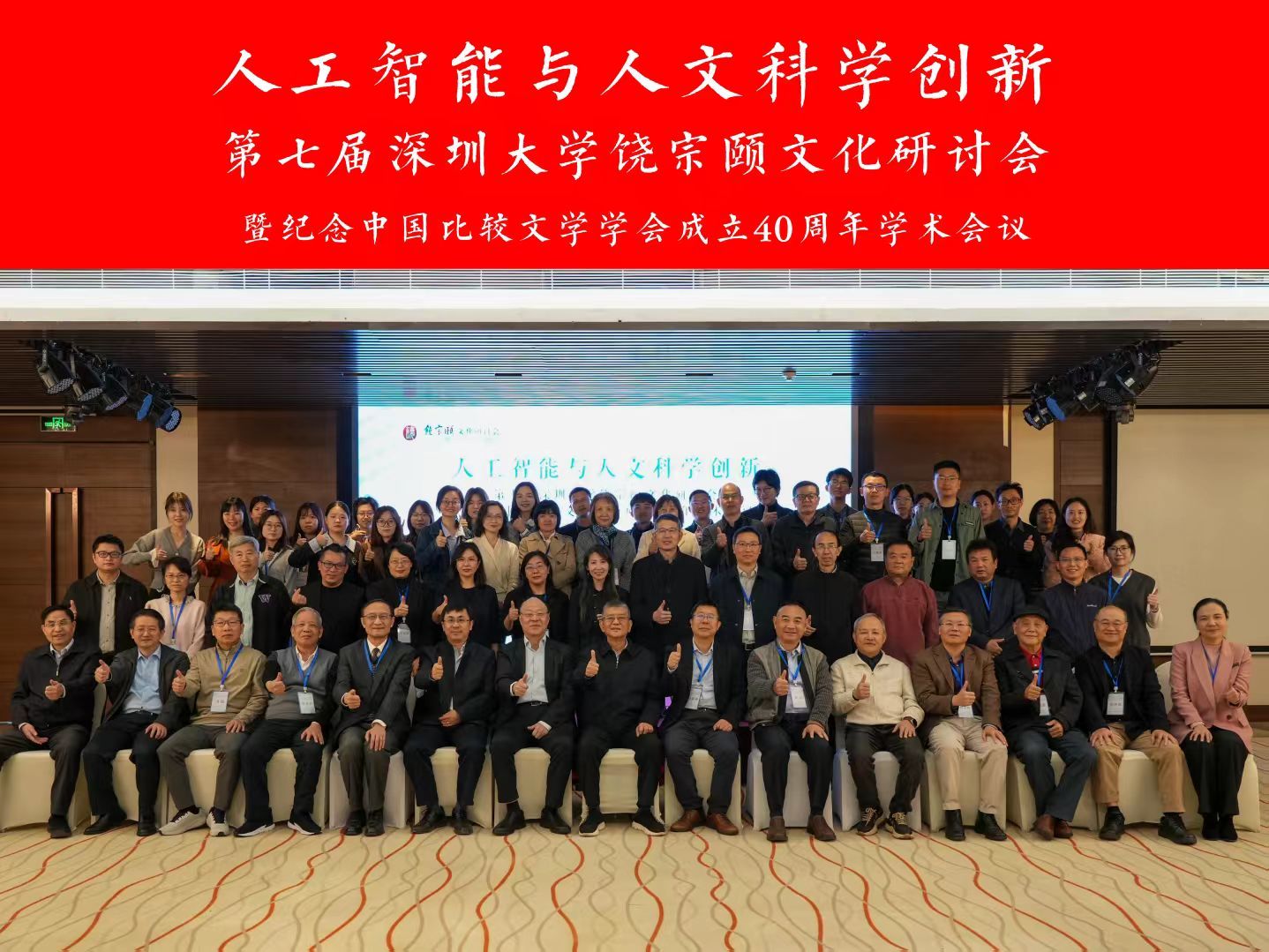
On November 29, the "Artificial Intelligence and Humanities Innovation" : The 7th Jao Tsung-I Culture Forum and the Academic Conference Commemorating the 40th Anniversary of the Chinese Comparative Literature Association was held at Shenzhen University. The event was co-hosted by Shenzhen University and the Center for the Comparative Study of World Civilizations of the Chinese Academy of Social Sciences, and organized by the Jao Tsung-I Cultural Research Institute, the School of Humanities, and the Institute of Comparative Literature and Comparative Culture at SZU. Over 80 experts, scholars and guests from domestic and overseas institutions—including Chinese Academy of Social Sciences, the National Culture and Art Think Tank, Tencent Group, Shanghai Jiao Tong University, Nanjing University, Sichuan University, Sun Yat-sen University East China Normal University, the Commercial Press, and Shenzhen University—participated both online and offline.
Chao Naipeng, Vice President of SZU, and Ma Yinmao, Director of the CASS Center for the Comparative Study of World Civilizations, delivered welcome speeches on behalf of the organizers. Chao Naipeng introduced that the Jao Tsung-I Cultural Research Institute is a vital academic platform based in the Greater Bay Area, dedicated to promoting humanities innovation and civilizational dialogue. It reflects SZU's persistent efforts in adhering to the "Two Integrations" and promoting the "Creative Transformation and Innovative Development" of fine traditional Chinese culture. SZU's research in humanities and social sciences actively embraces the advent of the AI era. The theme of this year's forum, "Artificial Intelligence and Humanities Innovation," represents SZU's proactive response to the impacts of the AI age. The Jao Tsung-I Culture Forum, now in its seventh edition, has consistently guided humanities research to answer the questions of the times, allowing the humanistic vitality of the Greater Bay Area to shine alongside the wisdom of the global academic community. Ma Yinmao pointed out that the CASS Center for the Comparative Study of World Civilizations focuses on researching international cultural trends, serving China's civilizational construction and cultural strategic needs through academic discussions and cultural exchanges. Co-hosting The 7th Jao Tsung-I Culture Forum with SZU aims to pool multi-disciplinary wisdom, clarify the developmental path of the humanities in the AI era, translate ideas into a solid force driving the innovative development of humanities and social sciences, and build a firm foundation for China's autonomous knowledge system. He Chengzhou, Vice President of the CCLA, delivered a speech noting that the association was born at SZU 40 years ago, marking the set-sail of Chinese comparative literature research in a new era. Returning to SZU for this 40th-anniversary commemorative conference holds extraordinary significance. Comparative literature is dedicated to crossing boundaries and bridging civilizations. Today, it should courageously bridge the "gap" between humanities and technology to build a forward-looking humanities disciplinary system with Chinese characteristics. Shi Xuezheng, Director of the Theory Division of the Publicity Department of the CPC Shenzhen Municipal Committee, attended and spoke at the forum. He emphasized that the Jao Tsung-I Culture Forum is a major brand based in the Greater Bay Area and facing the globe, promoting humanities innovation and dialogue. It serves as both an academic hallmark of SZU and a cultural calling card for Shenzhen. As China's Silicon Valley and a southern tech hub, Shenzhen constantly feels the surge of the AI wave. This places a responsibility on scholars to build a bridge between technology and the humanities, embrace AI development opportunities, co-write a new chapter for humanities and social sciences in the new era, and foster the "tech for good" development of an intelligent society.
The opening ceremony was chaired by Professor Tian Qibo, Executive Dean of the Jao Tsung-I Cultural Research Institute at SZU. Rao Qingfen, President of the Jao Link (Hong Kong), sent a congratulatory message wishing the forum great success.
The 7th Jao Tsung-I Culture Forum coincided with the 40th anniversary of the CCLA, which was founded at SZU in 1985. Returning to Shenzhen—a hotspot for technological and cultural innovation—the conference reflected on the development of the discipline of Chinese comparative literature and, facing the new challenges of "AI and Humanities," explored new opportunities and paths for the future development of Chinese humanities. Under the theme "Artificial Intelligence and Humanities Innovation," the forum centered around three topics: "Challenges and Innovations in Humanities in the Age of AI," "Humanistic Applications of AI: Philosophy and Literature," and "Comparative Literature Research in the Age of AI."
Challenges and Innovations in Humanities in the Age of AI
The surging wave of AI has brought unprecedented challenges to research methods and ethical paradigms in the humanities. Amidst this era of profound changes, the humanities are also incubating developmental opportunities through principled innovation, reshaping their epistemological value and social roles.
Wang Jingsheng, recipient of the UNESCO Confucius Medal, spoke on The Era Value and Cultural Construction of Artificial Intelligence. He noted that the central government's proposals for the "15th Five-Year Plan" frequently mention AI, highlighting its crucial role in the great rejuvenation of the Chinese nation. AI offers unprecedented opportunities: providing a chance to "overtake on the curve" in scientific and economic development, laying a solid foundation for creating a new form of human civilization, and serving as a crucial base for building a community with a shared future for mankind. Concurrently, cultural construction in the digital age requires building an "innovative, intelligent, inclusive, and powerful" culture of novel significance, constructing a digitally intelligent public cultural service system, and pushing new quality productive forces and cultural industries into a new stage. The core of new digital cultural formats is "Culture + AI," which essentially represents new quality productive forces in culture.
Si Xiao, Vice President of Tencent Group and Dean of Tencent Research Institute, presented on Humans Should Become the Measure of AI Development. He argued that AI is not a simple "job replacer" but a new-generation "era filter." It shifts the societal standard from "mastering knowledge" to the ability to "harness intelligence," "face the unknown," and "navigate uncertainty," testing whether one possesses an "AI-first" mindset. Mirrored by algorithms, human traits—judgment, proactivity, resilience, intuition, creativity, self-awareness, emotional management, and the ability to discern others' real needs and organize resources to solve problems—will elevate from "soft skills" to core hard strengths in the new era. These human traits are our strongest moats, not weaknesses. We must consciously hone these traits individually, while education systems must shift from knowledge instillation to systematic capability and personality cultivation. The meaning of AI lies not in replacing humans, but in reminding us to return to our inner selves and making humans the fundamental measure and guide for AI development.
Ye Shuxian, a Senior Professor of Liberal Arts at SJTU, discussed AI Humanities: After the End of the Anthropocene. He stated that the AI era marks the end of carbon-based intelligence's development and the comprehensive rise of silicon-based intelligence. This is a severe turning point in evolutionary history, potentially triggering long-term human brain degradation. However, AI and biotech are fundamentally altering human living conditions: smart machines will replace most physical and mental labor, bringing material abundance; the pain of childbirth may be eliminated via technology, and customized personalities will become possible. In culture, AI's massive output diminishes the value of traditional arts education and criticism; only genuine theoretical originality and conceptual pioneering can lead in the future era of human-machine synergy.
Xu Xinjian, Director and Professor of the Institute of Literature and Anthropology at SCU, warned in his speech Beware of "Pan-Intelligentism" (Algorithmic Determinism) that AI, as the core of digital-intelligent civilization, is driven by data, algorithms, and computing power. As this technology expands globally, the world is sliding toward the edge of "Pan-Intelligentism"—the danger of reducing everything (including humans) entirely into algorithmic systems controlled by preset backend programs, turning the world into mere objects of computation. Facing this techno-philosophical dilemma, the traditional Chinese educational philosophy of "Five Educations" (moral, intellectual, physical, aesthetic, and labor), championed since the late Qing Dynasty, offers unique humanistic value to counter the civilizational crisis brought by the inflation of technological rationality.
Liu Hongyi, Dean of the Jao Tsung-I Cultural Research Institute and Senior Professor of Liberal Arts at SZU, spoke on Artificial Intelligence and Knowledge Iteration: Starting from the Crisis of the Liberal Arts. He explained that knowledge has generational characteristics, and the essence of the liberal arts crisis is knowledge iteration. Under digital civilization, knowledge iteration encompasses both the humanities/social sciences and the natural sciences/applied technologies. From an evolutionary perspective, the advancement of intellect and the revolution of tools are two core pathways of knowledge evolution. These are now deeply overlapping due to AI's disruptive breakthroughs, challenging knowledge boundaries, production methods, definitions, attributes, and even the subjective meaning of humans. Therefore, AI should not be confined to an engineering or technical perspective. Instead, we must adopt a holistic view integrating science, philosophy, literature, and anthropology, blending Eastern and Western wisdom to uncover the fundamental principles of knowledge, and aligning technological algorithms with ethical and natural laws to serve the common welfare of humanity.
In the ensuing discussion, Professor Wu Junzhong from SZU stated that while tech drives progress, the humanities must not be weakened but should address real-world issues. Professor Peng Xiaogang from the College of AI at SZU argued that human-machine synergy is key; AI provides tools, while humanities inject values. Associate Professor Zhang Xiaofang from Shenzhen Polytechnic University cautioned against the ontological erosion posed by humanoid robots. Other participants in this sub-session included Associate Professor Li Xiaohong from Artois University (France), Sun Yanxu (General Manager of Commercial Press Shenzhen), Han Zhanning (Secretary-General of Hehu Think Tank), Yi Ling (Party Secretary of the School of Humanities, SZU), Assistant Professor Zhou Mingying, and Associate Researcher Ou Yulong from SZU.
Humanistic Applications of AI: Philosophy and Literature
AI is deeply penetrating core humanities fields like philosophy and literature, reshaping the interpretation of classical texts and the paradigms of thought experiments.
Ma Yinmao from CASS explored Why AI Cannot Become a Moral Subject. Drawing on contemporary AI ethics and Kantian philosophy (as posited by Dieter Schönecker), he noted that practical reason necessarily requires biological moral emotions (like respect), which AI lacks. While functionalists argue AI can simulate emotions, Ma pointed out that the fundamental issue isn't the lack of emotion, but the inability to establish Kantian "transcendental freedom." Because AI systems are essentially programmed and heteronomous, they cannot be true moral subjects, even with perfect emotional simulation.
Professor He Chengzhou from NJU discussed The Transmedial Turn in World Literature. He identified three levels of this turn: first, how reading and dissemination methods gain new vitality via cross-media adaptation; second, how world literature realizes its aesthetic and social functions through different media in specific contexts; and third, an emphasis on media materiality, valuing the deep integration of technological carriers and humanistic connotations.
Professor Zhan Wenjie from SYSU spoke on Human Cultural Reconstruction and Art Innovation in the AI Era. He positioned Large Language Models (LLMs) as "junior assistants" and "critical dialogue partners" for classical text research, not replacements. Effective human-machine collaboration requires the translator's professional leadership to guide AI through precise prompts, iterative refinement, and back-translation checks. AI frees translators from basic labor, allowing them to focus on domains machines cannot replace: conveying philosophical meaning, cultural context conversion, and stylistic shaping.
Professor Jin Wen from ECNU discussed Emotional Intelligence and the Social Function of Literary Studies in the AI Era. She defined emotional intelligence as both the ability to identify/respond to emotions and to govern the unconscious "dark matter" of the mind. Superior emotional intelligence balances emotional control with embracing randomness. While AI models cannot replicate the randomness of human bodily intuition, they can resonate with it. Human creators can fully collaborate with AI in artistic creation to optimize emotional "governance" models across society.
Professor Zhao Jingrong from Jinan University spoke on The Social Application of AI: Experience and Emotion in Literature. She argued that AI is also a contemporary political issue. The "politicization of AI" is achieved through the transformation and production of experience and emotion. Literature, as a core carrier of narrative and emotion, translates abstract technological power into perceivable, relatable political reality, profoundly shaping power orders in the era of human-machine symbiosis.
Professor Hua Yuanyuan from Dalian University of Foreign Languages explored Topic Modeling in Literary Studies. Addressing the complexity and polysemy of literary language, she proposed mapping topic keywords into a 3D semantic space to cluster similar terms, thereby enhancing the interpretability and readability of AI-generated poetry analysis.
During the discussion, Professor Jiang Yuqin from SZU noted that AI is prompting sci-fi theory to return to the roots of criticism (narrative, world, theory), advocating for a "cyborg poetics." Professor Guo Jie highlighted the dialectical unity of continuity and change in Chinese culture. Professor Tang Lixin addressed the spread of contemporary nihilism exacerbated by AI, calling for a philosophical breakthrough. Other discussants included Yuan Ronghong, Professor Liu Yan, Associate Professor Zhou Lei, Associate Professor Lin Yan, and Associate Professor Chen Yawen from SZU.
Comparative Literature Research in the Age of AI
AI presents a historic opportunity for comparative literature to break language barriers and conduct massive text analysis. However, maintaining humanistic insight amidst algorithmic objectivity remains a core challenge.
Wang Ning, Senior Professor of Liberal Arts at SJTU and Shanghai University, reviewed Chinese Comparative Literature Going Global: Historical Retrospect and Internationalization. He traced its three stages: the pre-disciplinary stage (1906–1949, pioneered by Wang Guowei and Lu Xun), the marginalized stage (1949–1977), and the institutionalization and full revival stage (1978–present). He urged scholars to continue the Sino-US bilateral dialogue initiated by Qian Zhongshu and amplify Chinese voices globally.
Professor Cao Shunqing from SCU delivered a speech titled Solving the "Choked Voice" Dilemma and Spreading Chinese Discourse to the World. He argued that while tech faces "choked neck" (bottleneck) problems, humanities face a "choked voice" dilemma—the inability of Chinese academia to make its voice heard internationally. This stems from Western discursive dominance and a lack of domestic cultural confidence (over-reliance on Western theories). To go global, Chinese academia must ground itself in the historical facts of civilizational mutual learning and propose theoretical concepts with both Chinese characteristics and global significance.
Professor Ge Guilong from Fujian Normal University discussed The "Dao" and "Path" of Chinese Comparative Literature in the AI Era. He urged leveraging AI through the perspective of the "Other" to promote mutual civilizational learning. By using data-driven cross-cultural text comparisons, scholars can empirically prove the commonality of human emotions while highlighting the unique value of specific civilizations, contributing to China's autonomous knowledge system.
Professor Su Ping from South China University of Technology examined Islands and Spatial Confinement in Sci-Fi Literature. Using affordance theory, she traced how islands historically served as closed spaces to evoke psychological horror. As contexts evolved, this function weakened, and creators shifted to new spatial containments like deep-sea ships, alien planets, and spaceships, expanding the emotional tension of enclosed narratives.
In the final discussion panel, Professor Yu Longyu of SZU paid tribute to Yue Daiyun, a key promoter of the CCLA's founding at SZU, remembering her academic contributions. Professor Zhang Guangkui discussed how literary canons are manipulated by socio-political motives. Professor Li Xiaojun analyzed the "late style" of modern American poets facing death. Professor Wang Chunjing explored Voltaire's writings on India. Other participants included Professor Yuiichi Umiura (Fukuoka International University), Lecturer Yoshitaka Umiura (Kurume University), and SZU faculty members Xu Tianji, Chen Yaxin, Wang Weijun, and Jiang Na.
The conference concluded that the rapid advancement of the new technological revolution is ushering humanity into an era driven by smart tech and universal interconnectivity. The humanities, as a historic system of knowledge transmission, are undergoing profound changes brought by AI. AI expands research content, methods, and tools, while pushing for a cognitive re-examination of the relationship between "human" and "technology." While disciplines like philosophy and literature gain unprecedented analytical capabilities, they also face paradigm shifts and ethical reconstruction. Maintaining humanistic independence and critical thinking during technological empowerment is the defining task of our time.
In his closing summary, Liu Hongyi reflected that since the Chinese comparative literature discipline began at SZU 40 years ago, it has acted as an intellectual vanguard globally. Pioneers like Yue Daiyun laid a solid foundation for cross-disciplinary and cross-cultural exchanges. Looking forward, comparative literature will play a unique role in addressing AI's challenges to the humanities. Upholding this innovative spirit, this forum successfully tackled the epochal proposition of "AI and Humanities." It was highly cross-disciplinary—blending science, philosophy, literature, and corporate tech practice—and deeply exploratory. He concluded that in the face of ongoing historical transformations, sparking intellectual collision and discovering the right questions is far more important than rushing to premature solutions.